
Some schools benefit from a traditional daily timetable, while others need longer instructional periods, rotating class sequences, or more flexible arrangements. The right choice depends on the school’s educational priorities, available resources, curriculum requirements, and the challenges administrators want to address. So, how do you determine which scheduling model is the best fit for your school?
5 School Scheduling Models: How They Work and What Sets Them Apart
Before exploring each model in detail, here’s a quick comparison of what sets them apart.
| Scheduling model | What sets it apart? | Main consideration |
| Traditional period scheduling | Students attend several shorter classes on a consistent daily timetable. | Frequent transitions and limited time for extended activities. |
| Block scheduling | Students have fewer, longer class periods. | Maintaining continuity between lessons and managing missed classes. |
| Rotating scheduling | Classes shift between time slots in a recurring cycle. | Keeping students and staff informed about changing schedules. |
| Modular or Flex-Mod scheduling | The day is divided into smaller units that can be arranged for different learning activities. | Coordinating students, teachers, rooms, and flexible periods. |
| Hybrid scheduling | Combines elements of different scheduling approaches. | Managing the additional constraints created by different timetable structures. |
One important distinction: These models are not always mutually exclusive. For example, a school can combine longer block periods with a rotating timetable. The best approach depends on how a school wants to organize instructional time and the needs it must accommodate.
1. Traditional Period Scheduling

Traditional scheduling divides the school day into several shorter class periods. Students typically attend different subjects each day, following a consistent timetable throughout the week.
Potential benefits:
- Provides a predictable daily routine for students and teachers.
- Allows students to revisit subjects frequently.
- Supports consistent lesson pacing and regular assessment.
- Can be easier to coordinate with established school routines.
Potential challenges:
- Shorter periods may limit time for extended projects, laboratory work, or in-depth discussions.
- Frequent transitions between classes can interrupt learning.
- Teachers may have less uninterrupted time for certain instructional activities.
May be a good fit for: Schools that prioritize consistent daily routines, frequent subject contact, and a familiar timetable structure.
2. Block Scheduling

Block scheduling organizes the school day around fewer, longer class periods rather than several shorter ones. This gives teachers more uninterrupted time for instruction, practical activities, discussions, and projects.
Common variations include:
- A/B block scheduling: Students alternate between two sets of classes on different days.
- 4×4 block scheduling: Students take a smaller number of courses each day, often completing a course within one semester before moving on to another set of courses.
Potential benefits:
- Gives teachers more time for practical activities, discussions, and project-based learning.
- Reduces the number of daily class transitions.
- Creates opportunities for extended instruction and collaborative work.
Potential challenges:
- Students may go longer between lessons for a particular subject.
- Missing a class can mean missing a substantial amount of instructional time.
- Schools may need to adjust lesson planning, assessment, and course pacing.
How it differs from rotating scheduling: Block scheduling focuses on the length and organization of class periods. Rotating scheduling focuses on when classes meet within a recurring cycle. A school can combine both approaches. For example, by using longer periods that rotate through different times of the day.
May be a good fit for: Schools that want longer instructional periods and have subjects that benefit from extended learning activities.
3. Rotating Scheduling
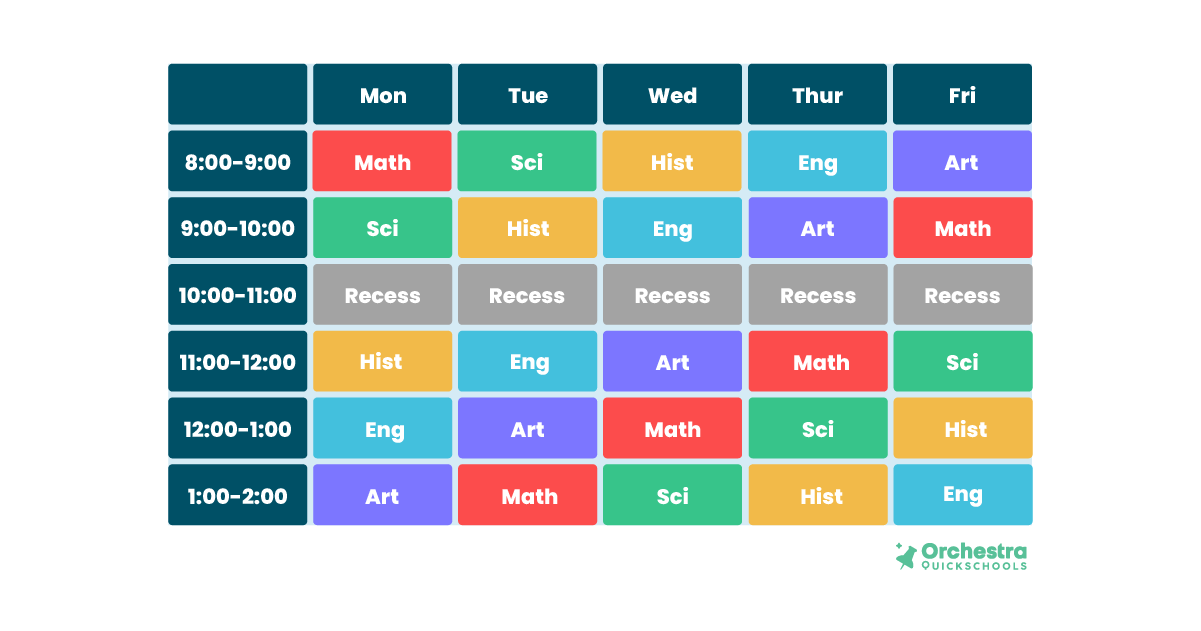
Rotating scheduling changes when classes meet according to a recurring timetable cycle, rather than assigning every subject the same time slot each day.
For example, a class that meets first period during one part of the cycle might meet later in the day during another. This allows subjects to rotate through different time slots instead of always occupying the same part of the school day.
Potential benefits:
- Gives subjects more equitable access to different times of the day.
- Reduces the likelihood that the same subjects always receive less favorable periods.
- Can provide variety in students’ daily routines.
Potential challenges:
- Students and teachers may need additional support to keep track of changing schedules.
- Planning and communication can become more complex.
- Schools must ensure that students still meet the required instructional time for each subject.
How it differs from A/B block scheduling: An A/B block schedule alternates between two sets of classes, while a rotating schedule shifts classes through different time slots over a recurring cycle.
May be a good fit for: Schools looking to distribute instructional time more evenly across the day or week.
4. Modular or Flex-Mod Scheduling
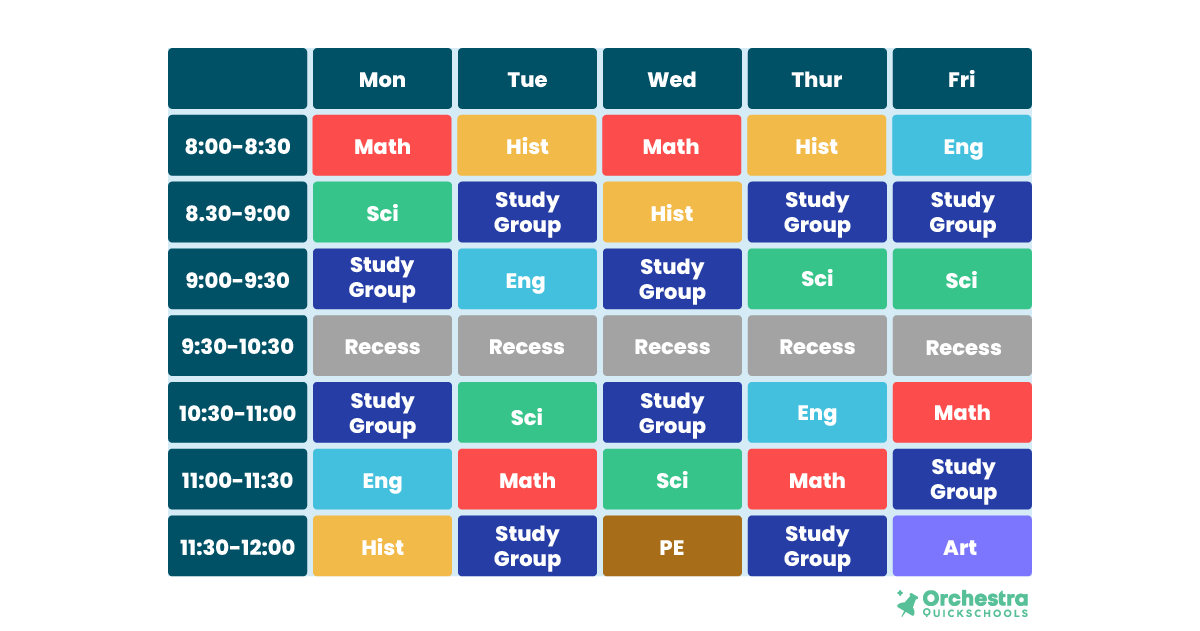
Modular scheduling divides the school day into smaller units of time, often called modules. These modules can be combined or arranged to support different instructional activities.
Depending on the school’s approach, students may have scheduled classes alongside flexible periods for independent study, small-group instruction, enrichment, or additional support.
Potential benefits:
- Allows greater flexibility in organizing instructional time.
- Supports individualized learning and targeted interventions.
- Creates opportunities for independent work and small-group activities.
- Can accommodate different lesson lengths and teaching approaches.
Potential challenges:
- Requires careful coordination of teachers, rooms, and student activities.
- Students may need guidance to manage independent learning time.
- Developing and maintaining the timetable can be more complex.
How it differs from traditional scheduling: Rather than assigning every class a fixed period in a uniform daily timetable, modular or Flex-Mod scheduling uses smaller time units that can be arranged to support different learning activities and student needs.
May be a good fit for: Schools that prioritize flexible learning experiences and have the resources to manage a more adaptable timetable.
5. Hybrid Scheduling
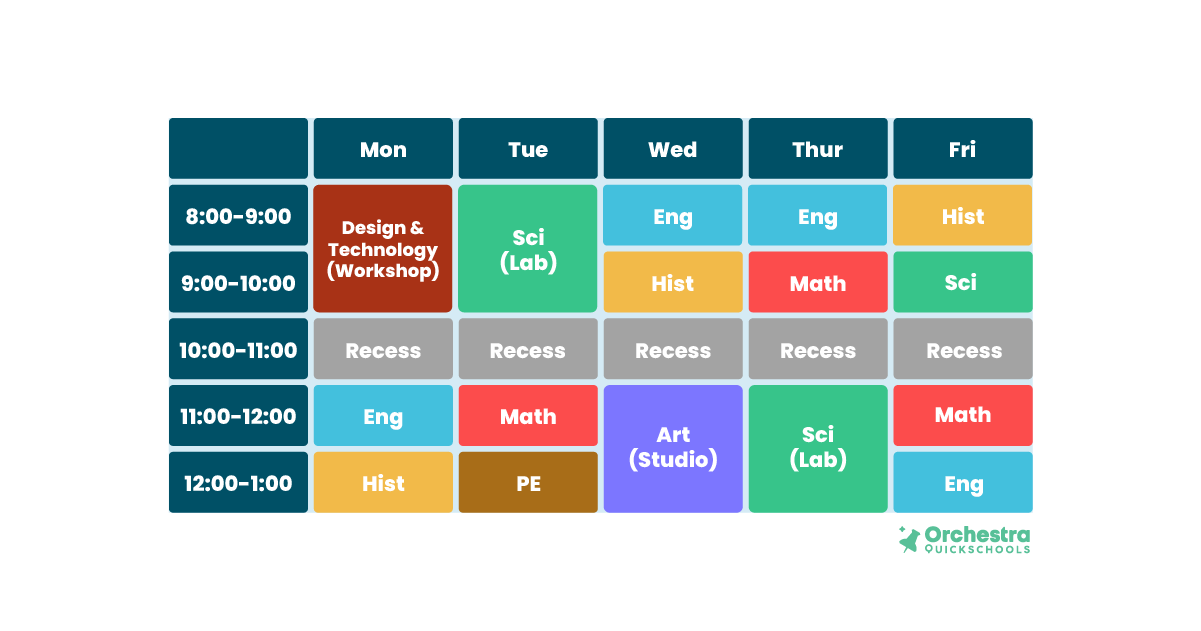
Hybrid scheduling combines elements of different scheduling models to suit a school’s particular needs. For example, a school might use traditional periods for some subjects and longer blocks for laboratory-based courses or practical activities.
Schools may also incorporate online learning or other flexible arrangements where appropriate.
Potential benefits:
- Allows schools to combine approaches that suit different subjects.
- Offers flexibility without requiring one scheduling structure for every class.
- Can support varied instructional methods and learning formats.
Potential challenges:
- Requires careful coordination across different timetable structures.
- Can create additional scheduling constraints for teachers and shared classrooms.
- Needs clear communication so students and staff understand the schedule.
How it differs from the other models: Hybrid scheduling is not one specific timetable format. It combines elements of other approaches, allowing schools to tailor their schedules to different instructional needs, departments, or programs.
May be a good fit for: Schools whose instructional needs vary across departments, subjects, or programs. This flexibility can also create opportunities to boost student success and help teachers thrive by better aligning instructional time with learning and teaching needs.
How to Choose the Right Scheduling Model

Schools can also use various methods to build a better schedule, depending on their scheduling priorities and requirements.
Step 1: Identify Your Main Challenges
Look at your current schedule and answer these 10 Questions to understand your needs. Start with the problems you want the new model to solve.
Step 2: Compare Your Options
Compare each model based on your school’s priorities, such as instructional time, student needs, teacher workloads, and flexibility.
Step 3: Check Your Resources
Make sure your school has the teachers, classrooms, and facilities needed to support the model. Consider how the change may affect daily operations and course availability.
Step 4: Review the Schedule
Before introducing the new model, check that students can access required courses, teachers are assigned appropriately, and classrooms are available when needed.
Common Mistakes to Avoid
When choosing a scheduling model, avoid these common mistakes:
- Following trends: A model that works for another school may not suit yours.
- Overlooking student needs: Make sure students can access required courses and electives.
- Ignoring resource limits: Check teacher availability and classroom capacity.
- Underestimating the changes required: A new model may require changes to lesson planning and daily routines.
- Skipping the final review: Check for scheduling conflicts before introducing the timetable.
Turn the Right Scheduling Model Into a Workable Plan
The best scheduling model is one that fits your students’ needs and works within your school’s real-world constraints. But choosing a model is only part of the process. Turning that model into a workable master schedule, however, takes the right tools, flexibility, and a way to navigate conflicts as plans evolve
Orchestra gives schools a more flexible scheduling environment to explore different scenarios, identify conflicts, and find workable solutions without having to start over every time plans change.
Your students deserve a schedule designed for their success. Give your school the tools to make it happen. Try Orchestra today.